
Swedish trees: broadleaf and conifer trees and how to recognise them
Updated
Short answer: the most common trees in Swedish forests are the Scots pine, the Norway spruce and the birch. Pine and spruce are conifers, and together they make up almost four fifths of all the wood in the forest. The birch is the most common broadleaf tree. Broadleaf trees have thin, broad leaves that fall in autumn in Sweden. Conifers have narrow, stiff needles that usually stay on for several years.
What is the difference between broadleaf trees and conifers?
Broadleaf trees (lövträd) have leaves: thin leaves that are more or less broad. In cold countries like Sweden the leaves only live for one summer. They open from the buds in spring and fall in autumn.
Conifers (barrträd) have needles instead of leaves. The needles are narrow, stiff and often prickly, and most of them stay on for several years, so the tree is green all winter. Conifers are rich in resin and often have a crown shaped like a pyramid.
The most common trees in Swedish forests
The Swedish University of Agricultural Sciences (SLU) measures every year how much wood is standing in the Swedish forest. This is how it is shared between the trees:
| Tree | Share of the wood in the forest |
|---|---|
| Tall, Scots pine | 40 per cent |
| Gran, Norway spruce | 38 per cent |
| Björk, birch | 13 per cent |
| All other trees together | 8 per cent |
Swedish conifers
- Tall, Scots pine, also called fur or fura: usually 20-30 m tall and can live for more than 700 years. The needles are blue-green to grey-green, 3-6 cm long and grow in pairs. The cones are 3-8 cm long and light brown.
- Gran, Norway spruce, also called rödgran: the second most common tree in the Swedish forest. It grows wild from Scandinavia to the Alps and the Balkans and east through Russia. The spruce is the provincial flower of Medelpad.
- En, juniper: common all over Sweden. It grows mostly on grassy slopes and heaths, often many together, but also here and there in the forest.
- Idegran, yew: a shrub of 2-3 m or a tree of up to 15 m. It grows slowly and can live for up to 1,000 years. The needles are soft, glossy dark green on top and paler underneath.
Swedish broadleaf trees
| Tree | Height | How to recognise it |
|---|---|---|
| Vårtbjörk, silver birch | up to 25 m | white and dark bark, rough on older trees; triangular, double-toothed leaves that turn yellow in autumn |
| Glasbjörk, downy birch | up to 25 m | white, grey or copper-brown bark without black patches; often grows as a shrub on bogs |
| Ek, oak | 20-25 m | coarse, light grey bark that cracks into narrow plates; a broad, crooked crown |
| Bok, beech | 30-40 m | a straight, pillar-like trunk with smooth, silver-grey bark; oval leaves |
| Ask, ash | up to 30 m | pinnate leaves with several leaflets; furrowed bark on older trees |
| Lönn, Norway maple | 20-25 m | hand-shaped leaves with five lobes and strong red and yellow autumn colours |
| Lind, small-leaved lime | up to 30 m | round, heart-shaped leaves with a point; flowers in July |
| Skogsalm, wych elm | 30-40 m | very rough leaves, 8-15 cm, with a lopsided base |
| Rönn, rowan | up to 15 m | grey, smooth and shiny bark; white flowers in May-July and orange-red berries |
| Asp, aspen | up to 25 m | round leaves on flat stalks, which tremble in the slightest wind |
| Sälg, goat willow | a tree or tall shrub | flowers early in spring with catkins on short stalks |
| Klibbal, black alder | up to 20 m | a straight trunk with dark, cracked bark |
The oak is one of the most important trees for animals and plants: at least 1,500 species depend on it to some degree. Sweden's thickest oak, Kvilleken near Vimmerby, is 14 metres round and was estimated in 2014 to be 750-950 years old.
Noble broadleaf trees
Oak, elm, ash, maple, lime and hornbeam are called noble broadleaf trees (ädla lövträd), and sometimes the beech is counted too. They need a fair amount of warmth and are southern trees in the Nordic countries. Most of them are common only as far north as Svealand.
The posters
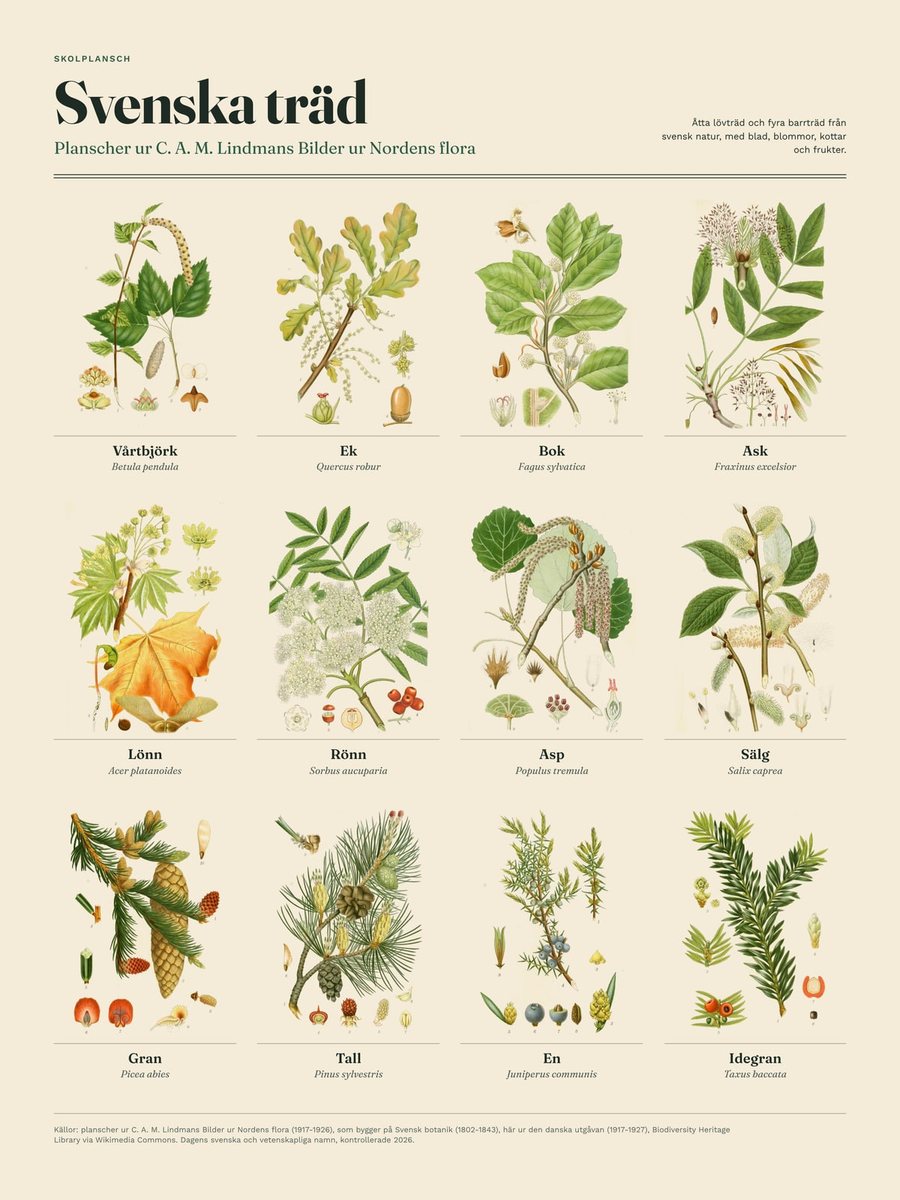
Our school chart Svenska träd (Swedish trees) shows eight broadleaf trees and four conifers: silver birch, oak, beech, ash, Norway maple, rowan, aspen, goat willow, Norway spruce, Scots pine, juniper and yew, with leaves, flowers, cones and fruits. The pictures are colour plates from the botanist C. A. M. Lindman's Bilder ur Nordens flora from 1917-1926. In the series Fyra träd (Four trees) the oak, silver birch, spruce and pine each have a poster of their own, with a few facts about the tree under the picture. The posters are in Swedish.
Eight broadleaf trees and four conifers with leaves, flowers, cones and fruits on one school chart.