
The planets in order: the solar system's eight planets from the Sun
Updated
Short answer: the solar system has eight planets. In order from the Sun they are Mercury, Venus, Earth, Mars, Jupiter, Saturn, Uranus and Neptune. The largest is Jupiter and the smallest is Mercury. Pluto was counted as a planet until 2006 and is now called a dwarf planet.
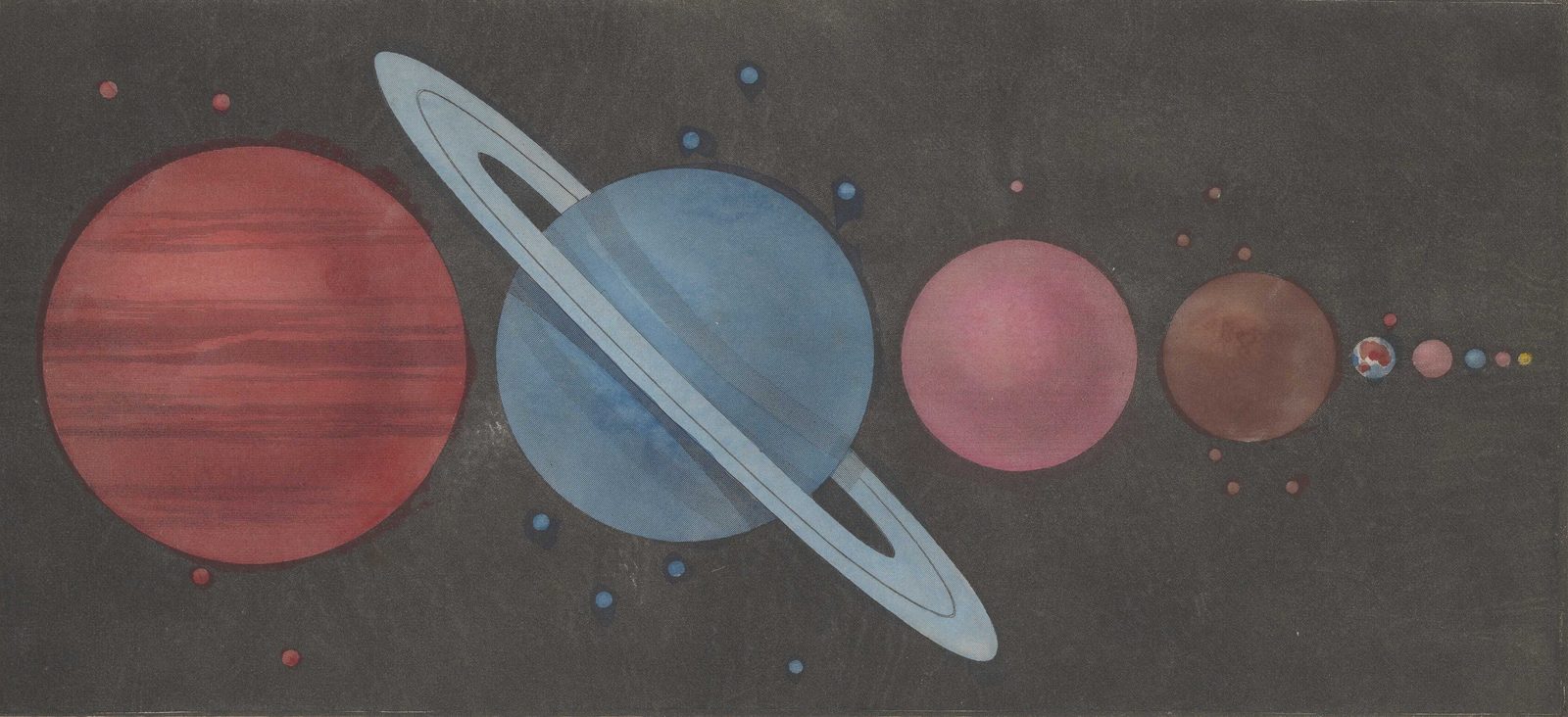
The planets in order from the Sun
| No. | Planet | Diameter | Distance from the Sun | One orbit of the Sun |
|---|---|---|---|---|
| 1 | Mercury | 4,880 km | 57.9 million km | 88 days |
| 2 | Venus | 12,100 km | 108.2 million km | 225 days |
| 3 | Earth | 12,760 km | 149.6 million km | 365 days |
| 4 | Mars | 6,790 km | 228.0 million km | 687 days |
| 5 | Jupiter | 143,000 km | 778.5 million km | 11.9 years |
| 6 | Saturn | 121,000 km | 1,432 million km | 29.4 years |
| 7 | Uranus | 51,100 km | 2,867 million km | 84 years |
| 8 | Neptune | 49,500 km | 4,515 million km | 165 years |
The distance is the mean distance, because the planets' orbits are not quite round. Light from the Sun takes a little more than eight minutes to reach the Earth, and four hours to reach Neptune.
A rhyme for the order of the planets
The order is easier to remember with a sentence where each word starts with the same letter as a planet. In Swedish we use:
Min Vän Jonas Målar Jättestora Svarta Ugglor Nattetid (My friend Jonas paints huge black owls at night).
The planets in Swedish are Merkurius, Venus, Jorden, Mars, Jupiter, Saturnus, Uranus and Neptunus. In English you could say: My Very Easy Method Just Speeds Up Naming. Making up your own sentence with the children is often what makes it stick.
Rocky planets, gas giants and ice giants
The four inner planets, Mercury, Venus, Earth and Mars, are rocky planets with a solid surface. They are like the Earth and are also called the terrestrial planets. The four outer planets are giant planets. Jupiter and Saturn are gas giants, and Uranus and Neptune are called ice giants.
Which is the largest and which is the smallest planet?
Jupiter is the largest planet in the solar system. It is 143,000 km across, about eleven times as wide as the Earth. Saturn is the second largest. The smallest planet is Mercury, 4,880 km across, a little more than a third of the Earth's width. Mercury is also the planet closest to the Sun.
How many planets are there? And what happened to Pluto?
There are eight planets in the solar system. Pluto was counted as the ninth planet from its discovery until 2006. That year the International Astronomical Union (IAU) decided that Pluto is a dwarf planet instead. A dwarf planet is large enough to be round, but it is smaller than all eight planets and has not cleared other bodies out of the way around its orbit. Pluto is one of the largest dwarf planets.
Planets you can see without binoculars
Five of the planets have been known since ancient times, because they can be seen with the naked eye: Mercury, Venus, Mars, Jupiter and Saturn.
- Venus is only seen in the morning or the evening, which is why it is called the Morning Star and the Evening Star.
- Mars is called the red planet, after its colour.
- Jupiter shines yellowish white. With small binoculars you can see its four largest moons.
- Saturn shines yellowish, about as bright as the brightest stars.
- Mercury is hard to see from Sweden.
Facts about each planet
- Mercury is the innermost and smallest planet. A year there, one orbit of the Sun, takes only 88 days.
- Venus is almost as large as the Earth and has the orbit just inside the Earth's.
- Earth is the third planet from the Sun and the only body where we know there is life. It has one moon.
- Mars has two small moons and is about half as wide as the Earth.
- Jupiter is the largest of all the planets. It holds more than all the other planets put together.
- Saturn is famous for its rings. Its density is lower than water's, so it is lighter than the same amount of water, and it has 274 known moons.
- Uranus spins lying on its side, with its axis tilted almost 98 degrees. One orbit of the Sun takes 84 years.
- Neptune is the outermost planet. It was discovered in 1846, and one orbit of the Sun takes 165 years.
The poster
John Emslie drew and engraved the planets at their true sizes against each other around 1850, in a series of astronomy pictures published in London. The plate shows the eight planets we count today, but the colours are his own: Mars is blue and Jupiter red. Neptune had just been discovered and was drawn larger than Uranus, though today we know Uranus is a little larger. On our poster Solsystemet (The solar system) the planets' Swedish names are under the picture, with today's facts for all eight planets, checked against NASA and JPL. The poster is in Swedish.
The planets at their true sizes against each other, in a hand-coloured plate from around 1850, with today's facts in Swedish.