
Birds at the bird table: how to tell Sweden's winter birds apart
Updated
Short answer: the most common birds at the bird table in Sweden are the great tit, the blue tit, the tree sparrow, the blackbird and the bullfinch. That was the list when BirdLife Sweden counted winter birds in January 2026, and the great tit has been number one every year since the count began. Below is how to tell the common birds apart by their colours, and how to feed them.
The most common birds at the bird table
Every winter, at the end of January, thousands of people count the birds at their bird tables and report them to BirdLife Sweden. The count is called Vinterfåglar inpå knuten (winter birds close to home). In 2026 about 19,400 reports came in, and the ten most common birds were:
- Talgoxe, great tit
- Blåmes, blue tit
- Pilfink, tree sparrow
- Koltrast, blackbird
- Domherre, bullfinch
- Gulsparv, yellowhammer
- Skata, magpie
- Grönfink, greenfinch
- Kaja, jackdaw
- Gråsparv, house sparrow
The blackbird set a record in 2026: on average just over 3.9 blackbirds per report, the highest in the count's history.
A yellow bird at the bird table
- Talgoxe, great tit, about 14 cm: green back, black head with white cheeks and a black stripe down the middle of the yellow belly.
- Blåmes, blue tit, 12 cm: yellow belly, blue wings and tail, a blue cap on the white head and a black stripe through the eye.
- Grönfink, greenfinch, 14-15 cm: olive green above and yellowish green below, with a yellow band along the edge of the wing. The female is greyer green.
- Grönsiska, siskin, 11.5-12.5 cm: green above with fine dark streaks and yellow below. The male has a black crown and chin.
- Gulsparv, yellowhammer, 16-17 cm: brown and streaked above, yellow on the head and belly and reddish brown on the rump.
The great tit and the blue tit are easy to mix up from a distance. Look at the head: the great tit has a black head, the blue tit a white head with a blue cap.
A bird with a red breast
- Rödhake, robin, 14 cm: grey-brown above and white below, with a rust-orange breast and throat.
- Domherre, bullfinch, 16 cm: black and grey above with a white rump. The male is red below, the female grey-brown.
- Gråsiska, redpoll, 11.5-13 cm: grey-brown and speckled, with a red forehead and a black chin. Old males are rosy red on the breast.
- Steglits, goldfinch, 12-14 cm: a red face, a white and black head and broad yellow bands on the black wings.
- Större hackspett, great spotted woodpecker, 22-23 cm: black and white, with a bright red patch under the tail. The male also has a red nape.
The robin is rust-orange only on its breast and throat. The male bullfinch is red over its whole underside, with black and grey on its back.
A black and white bird
All black are the male blackbird and, from a distance, the jackdaw.
- Skata, magpie, 43-50 cm, half of it tail: black with a white belly and white shoulders. The black shines green and blue.
- Stjärtmes, long-tailed tit, 12-14 cm: mottled black and white, with a short bill and a long tail. The long-tailed tits of Sweden have an all-white head.
- Större hackspett, great spotted woodpecker: see above, black and white with red under the tail.
- Kaja, jackdaw, about 33 cm: dark grey-black with a paler grey nape and, as an adult, pale eyes.
- Koltrast, blackbird, 24-25 cm: the male is coal black with a yellow bill, the female brown with a yellowish brown bill.
Small brown and grey birds
- Pilfink, tree sparrow, about 14 cm: an all-brown crown and a black spot on the cheek.
- Gråsparv, house sparrow, 14-15 cm: the male has a grey crown, a chestnut nape and a black chin and breast. The tree sparrow and the house sparrow are often mixed up: look for the black cheek spot, which only the tree sparrow has.
- Järnsparv, dunnock, 14-15 cm: dark grey on the head. Most Swedish dunnocks fly south for the winter.
- Entita, marsh tit, 12 cm: grey-brown above and pale below, with a black crown and chin. The willow tit (talltita) is almost the same but has a pale band along the wing.
- Tofsmes, crested tit, 11-12 cm: grey-brown above, with a black and white head and a black-speckled crest.
- Svartmes, coal tit, 11-12 cm: grey above and dull beige below, with a black head and a big white cheek patch like the great tit's.
- Nötväcka, nuthatch, about 14 cm: blue-grey above, white and reddish brown below, and a black stripe from the bill to the nape.
- Bergfink, brambling: a close relative of the chaffinch, but always with a white rump. In winter the male is less colourful and looks more like a chaffinch.
Some winters, waxwings (sidensvans) also come to southern Sweden in large flocks. They are the size of a starling, grey with a crest, and have yellow and red on the wings.
How to feed the birds
BirdLife Sweden gives some simple advice on feeding birds:
- Feed from November to April.
- Give seeds, peanuts, fat and apples.
- Feeders and tubes are a good choice.
- Give a little at a time and fill up often.
- Clean the bird table a couple of times during the season with warm water and washing-up liquid.
- If you see sick birds, stop feeding for two to four weeks.
Fat balls are often sold in a net. Take the net off before you hang up the ball, so that the birds do not get caught in it.
The posters
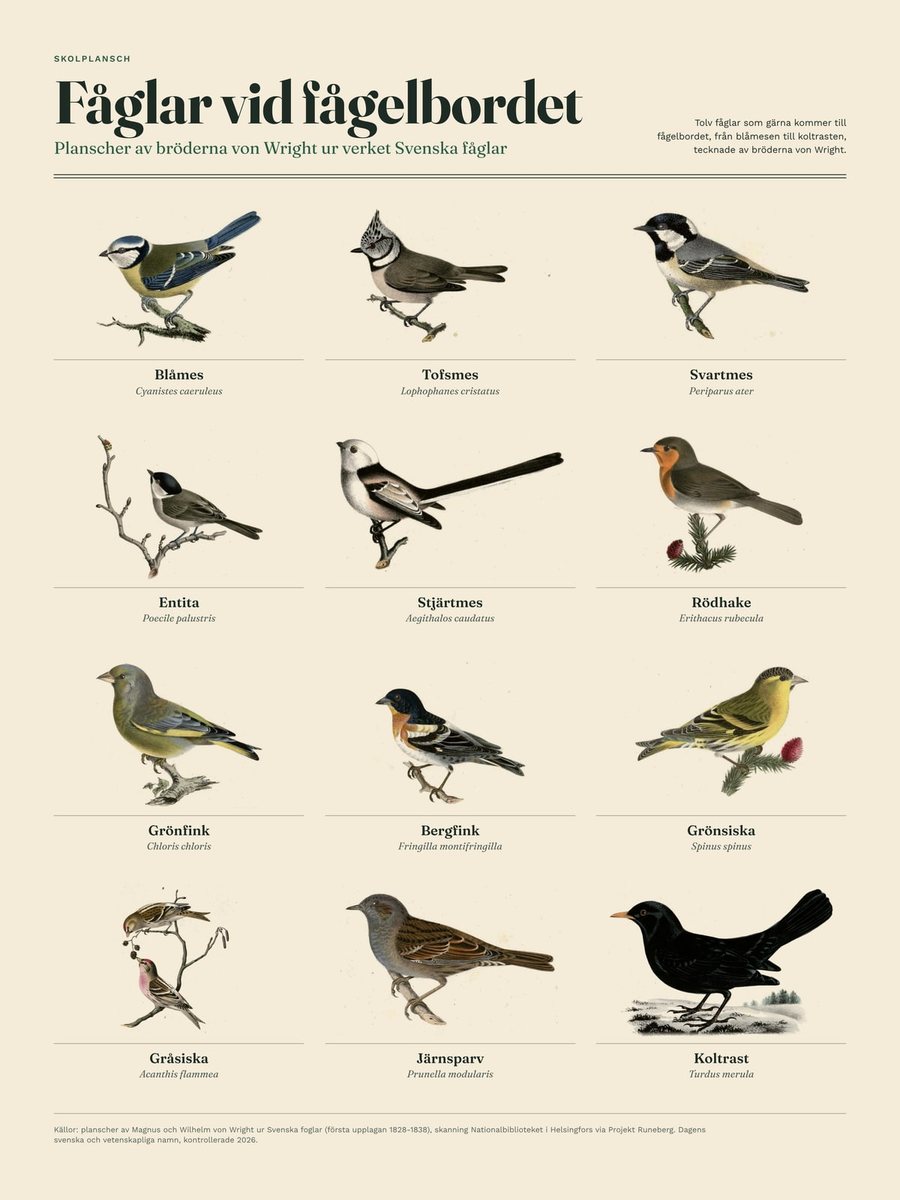
Our school chart Fåglar vid fågelbordet shows twelve birds that like to visit the bird table: the blue tit, crested tit, coal tit, marsh tit, long-tailed tit, robin, greenfinch, brambling, siskin, redpoll, dunnock and blackbird. The pictures are lithographs by the von Wright brothers from Svenska foglar, published in 1828-1838. In the series Fåglar vid huset (Birds by the house) the great tit, blue tit, robin and bullfinch each have a poster of their own, made to hang side by side. The posters are in Swedish.
Twelve birds that like to visit the bird table, in the von Wright brothers' plates from 1828-1838.