
How to read runes
Updated
You read a runestone in three steps. First swap each rune for its letter. Then try the sounds the rune can stand for, until the words sound like Swedish. Last, translate into today's language. The runes on Viking Age stones come from the Younger Futhark, a rune row of only 16 signs, so it is quicker to learn than you might think.
Which runes are on the runestones?
Most Swedish runestones were raised in the 1000s and are carved with the Younger Futhark. That row was complete in the early 700s and was used throughout the Viking Age. Before it came the Elder Futhark with 24 runes, which you only meet on a few older stones.
The Younger Futhark comes in two main forms. Long-branch runes are the most common on the stones of the 1000s. Short-twig runes are a simpler form with shorter twigs, common in the 800s and 900s, for example on the Rök stone in Östergötland. They are the same 16 runes, but nine of them have a simpler shape. A third, rare form, staveless runes, is found mainly on a few stones in Hälsingland and Medelpad.
The Elder and the Younger Futhark
Runic writing is the old script of the Germanic peoples. The word futhark is made from the first six runes of the rune row, which is why it is sometimes written futhork. There are two rune rows:
- The Elder Futhark has 24 runes. It is the older one and is found on only a few stones in Sweden.
- The Younger Futhark has 16 runes. It was complete in the early 700s, and it is the one you read on most Swedish runestones. It is the one on our poster.
A famous stone with the Younger Futhark is the Rök stone (Rökstenen) at Rök church in Östergötland. It was raised in the 800s, stands two and a half metres above the ground and has more than 750 runes, the longest runic inscription known. It is carved in short-twig runes. With that much text it is not a stone to start with, so practise on a shorter one, like the Gripsholm stone further down.
The 16 runes
The row is divided into three ætts (ätter). Runologists write each rune with a fixed letter. The picture shows the runes in their long-branch form as they are on our poster, with letter, name, meaning and sounds; the poster's words are Swedish.
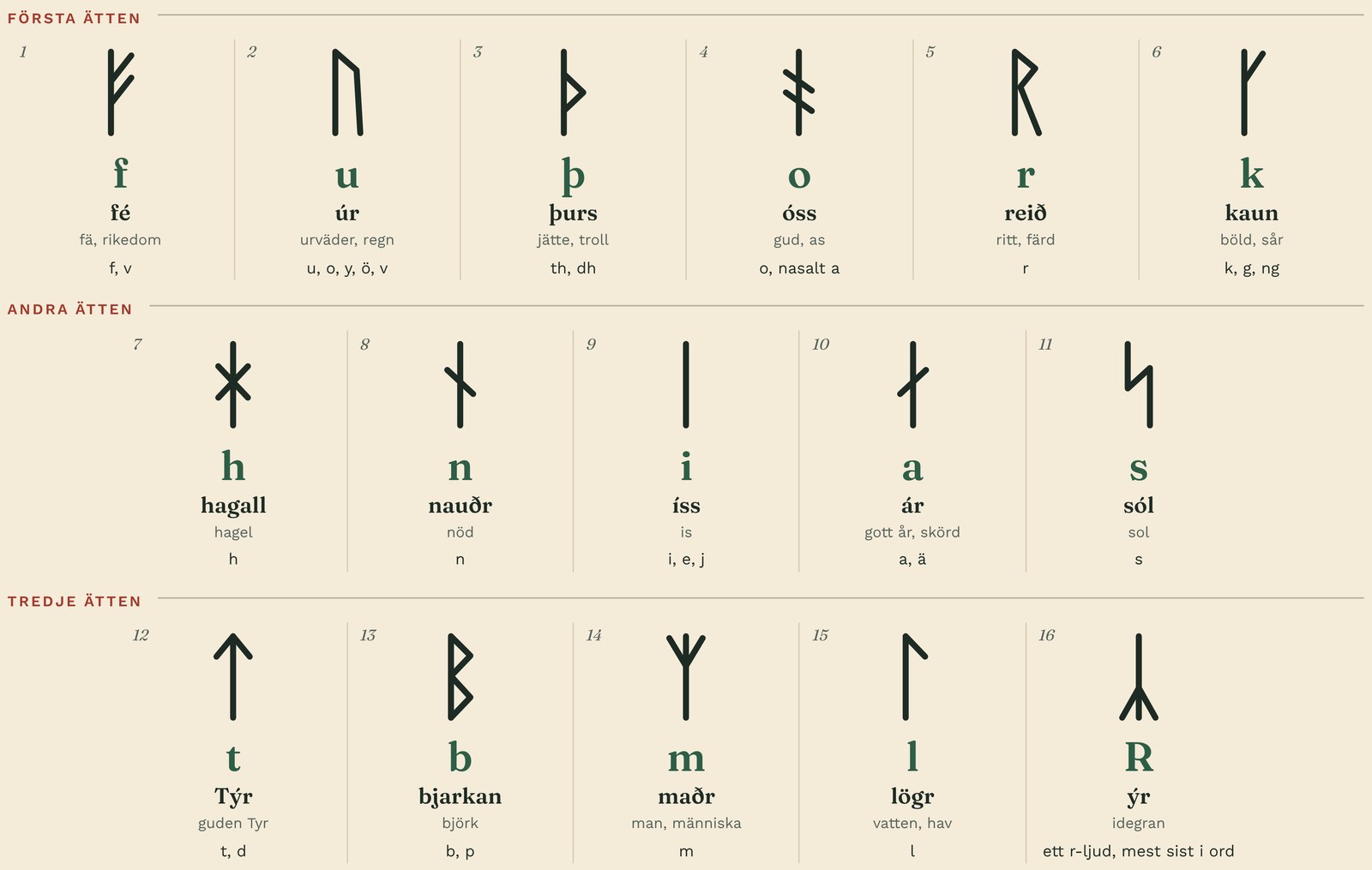
The same as a table, in the row's order:
| No. | Letter | Sounds | Name |
|---|---|---|---|
| 1 | f | f, v | fé (cattle, wealth) |
| 2 | u | u, o, y, ö, v | úr (rain) |
| 3 | þ | th, dh | þurs (giant) |
| 4 | o | o (in older inscriptions a nasal a) | óss (god) |
| 5 | r | r | reið (ride) |
| 6 | k | k, g, ng | kaun (ulcer) |
| 7 | h | h | hagall (hail) |
| 8 | n | n | nauðr (need) |
| 9 | i | i, e, j | íss (ice) |
| 10 | a | a, ä | ár (good year) |
| 11 | s | s | sól (sun) |
| 12 | t | t, d | Týr (the god Tyr) |
| 13 | b | b, p | bjarkan (birch) |
| 14 | m | m | maðr (man) |
| 15 | l | l | lögr (water) |
| 16 | R | an r-sound, mostly at the end of words | ýr (yew) |
The rune þ sounds like th in thing, and like th in this when it stands for dh. The names are the Old Norse names the Icelandic and Norwegian rune poems give the runes.
One rune, several sounds
The language had more sounds than the row had signs. So most runes had to stand for several sounds:
- k and g are written with the same rune, and so are t and d and b and p.
- The u-rune can be u, o, y, ö or v. The i-rune can be i, e or j. The a-rune can be a or ä.
- Long and short vowels are written the same way.
- The R-rune, the last in the row, stood for an r-sound of its own that was mostly found at the end of words, for example in þaiR (they).
This means you often have to try your way. Read the letters aloud and change the sounds until you hear a word. Many words on the runestones are still close to modern Swedish.
Where does the text start?
On a runestone the runes stand in a band, often shaped as a snake or a dragon. Follow the band. The text may run to the right or to the left; if the runes look mirrored, read the other way.
Between the words there is often a divider: a dot, two dots, a small cross or a short stroke. Sometimes there is none, and you have to find where a word ends yourself.
An example: the Gripsholm stone
Runologists present an inscription in three steps: first the runes in our letters in bold, then how the words were pronounced in italics, last what they mean. This is the start of the Gripsholm stone (Sö 179) in Södermanland, one of Sweden's best-known runestones from the 1000s. The picture shows the first five words with the runes from our poster:

tula : lit : raisa : stain : þinsat : sun : sin : haralt : bruþur : inkuars
Tola let ræisa stæin þennsa at sun sinn Harald, broður Ingvars.
"Tola had this stone raised in memory of her son Harald, Ingvar's brother."
Look at how the runes are used:
- tula becomes Tola: the u-rune stands for o here.
- lit becomes let (had, let): the i-rune stands for e.
- raisa and stain become ræisa (raise) and stæin (stone): the a-rune stands for ä.
- þinsat becomes þennsa at (this, in memory of): the i-rune stands for e, nn is written with a single rune, and the a-rune belongs to both words.
- haralt becomes Harald: the t-rune stands for d.
- inkuars becomes Ingvars: the k-rune stands for g and the u-rune for v.
The rest of the stone is a poem about Ingvar's journey east. It begins þaiR furu trikila fiari at kuli, "they travelled boldly far for gold". Here kuli stands for gulli (gold): k for g, and ll written with one rune.
How to get started
- Keep the rune row in front of you.
- Write the letter under each rune.
- Split into words at the dividers.
- Try the runes' other sounds until the words sound familiar.
- If there is a sign by the stone, compare with the reading on it.
Want the rune row on your wall while you practise? The Runalfabetet poster shows all 16 runes with letter, name and sound, the short-twig runes in a row of their own and the start of the Gripsholm stone to read yourself. The poster's text is in Swedish.
All 16 runes with names and sounds on one poster.