
All posters / Provincial flowers
The provincial flowers of Sweden
Every province (landskap) in Sweden has its own flower: cowslip in Närke, twinflower in Småland, snake's head fritillary in Uppland and harebell in Dalarna. Our poster Sveriges landskapsblommor has all 25 provinces, each with its flower, the flower's Swedish name and its scientific name. The provinces are placed roughly as on a map, with Lappland and Norrbotten at the top and Skåne and Öland at the bottom, so it is easy to find your own.
The poster
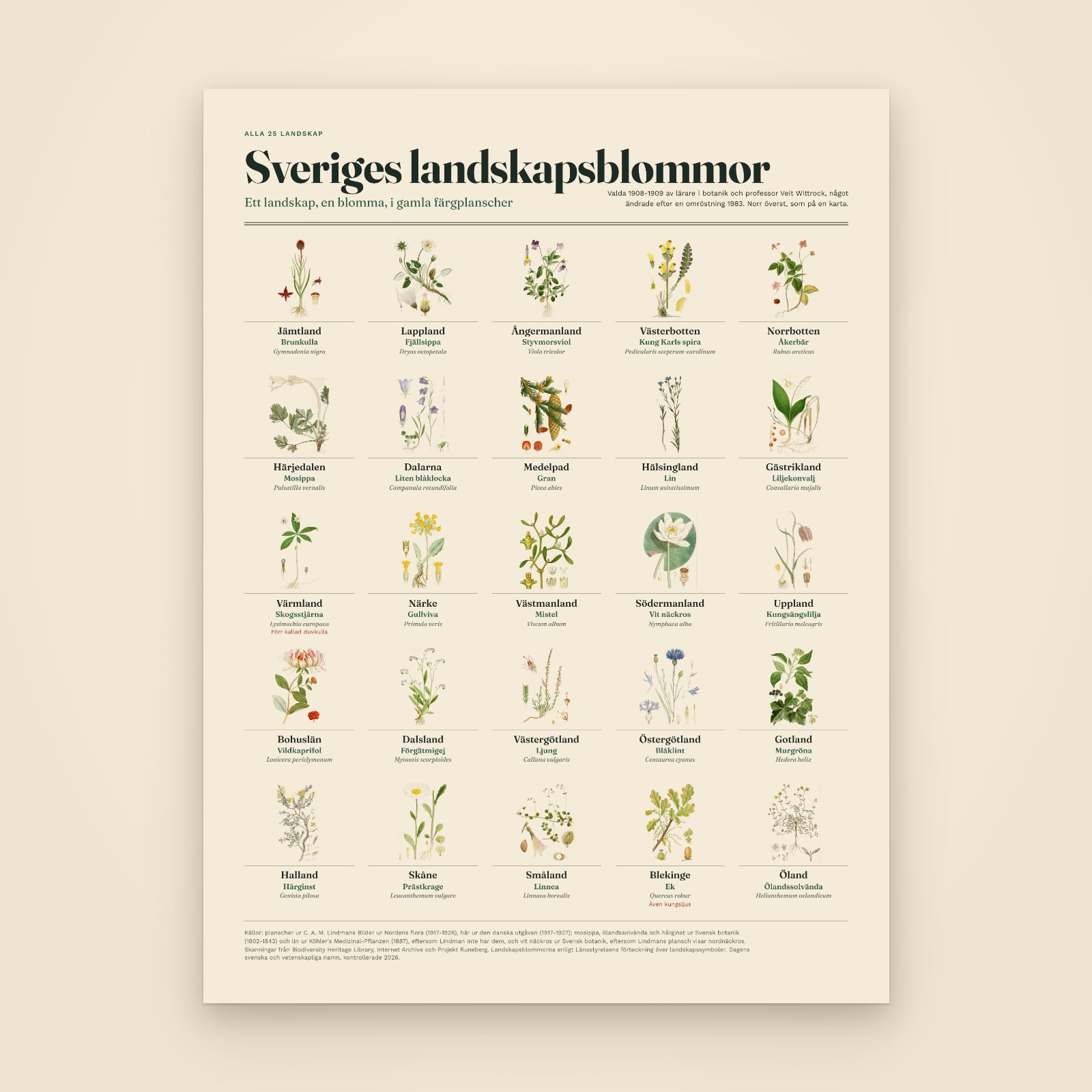
All 25 provincial flowers: Blekinge oak and great mullein, Bohuslän honeysuckle, Dalarna harebell, Dalsland forget-me-not, Gotland ivy, Gästrikland lily of the valley, Halland hairy greenweed, Hälsingland flax, Härjedalen spring pasqueflower, Jämtland black vanilla orchid, Lappland mountain avens, Medelpad Norway spruce, Norrbotten arctic bramble, Närke cowslip, Skåne oxeye daisy, Småland twinflower, Södermanland white water lily, Uppland snake's head fritillary, Värmland chickweed wintergreen, Västerbotten moor-king lousewort, Västergötland heather, Västmanland mistletoe, Ångermanland wild pansy, Öland Öland rock-rose and Östergötland cornflower.
The idea came in 1908. Botany teachers all over the country proposed a flower for each province, and professor Veit Wittrock decided the final list, which was printed in the 1909 edition of Svenska kalendern. After a vote in 1983 the list was changed a little. The poster follows the county administrative board's list of provincial symbols, where Blekinge has two flowers: the oak and the great mullein.
Most of the pictures are old colour plates from the botanist C. A. M. Lindman's Bilder ur Nordens flora, from the early 1900s. Four of the flowers are not in Lindman. The spring pasqueflower, the Öland rock-rose and the hairy greenweed therefore come from Svensk botanik of the 1800s, which many of Lindman's plates are built on, and flax from a German book of medicinal plants of 1887. The white water lily also comes from Svensk botanik, as Lindman's picture shows its northern relative, nordnäckros. The names were checked in 2026.
Framed, the poster suits anyone from a particular province, a classroom or anyone who loves flowers and nature. The poster's text is in Swedish. It is printed in Europe on 200 g matt, uncoated paper in 30 x 40 or 50 x 70 cm. In 30 x 40 cm it also comes with a black, white or natural wood frame.
Common questions
Short answers about the poster. If you wonder about anything else, write to us.
Who decided the provincial flowers?
Professor Veit Wittrock decided the list in 1908-1909, from proposals by botany teachers all over the country. After a vote in 1983 it was changed a little. The poster follows the county administrative board's list of provincial symbols.
Are the pictures old plates?
Yes. 20 of the pictures come from C. A. M. Lindman's Bilder ur Nordens flora from the early 1900s. The spring pasqueflower, the hairy greenweed and the Öland rock-rose come from Svensk botanik of the 1800s and flax from a German book of medicinal plants of 1887, as Lindman has none of them. The white water lily also comes from Svensk botanik, as Lindman's picture shows nordnäckros, its northern relative. We have removed the old captions and printed today's names below.
How long does delivery take?
Usually 5-8 working days. The poster is printed in Europe after you order and sent straight from the printer to a service point near you. You get an email with a tracking link when the parcel is on its way.