
Spring flowers: how to recognise Sweden's common wild spring flowers
Updated
Short answer: some of the best-known wild spring flowers in Sweden are coltsfoot, hepatica, wood anemone, lesser celandine and cowslip, and a little later lily of the valley. Coltsfoot and hepatica are among the first. The wood anemone flowers in April and May, and the lily of the valley in May and June. Below is how to recognise them by their colour, and which ones you may not pick.
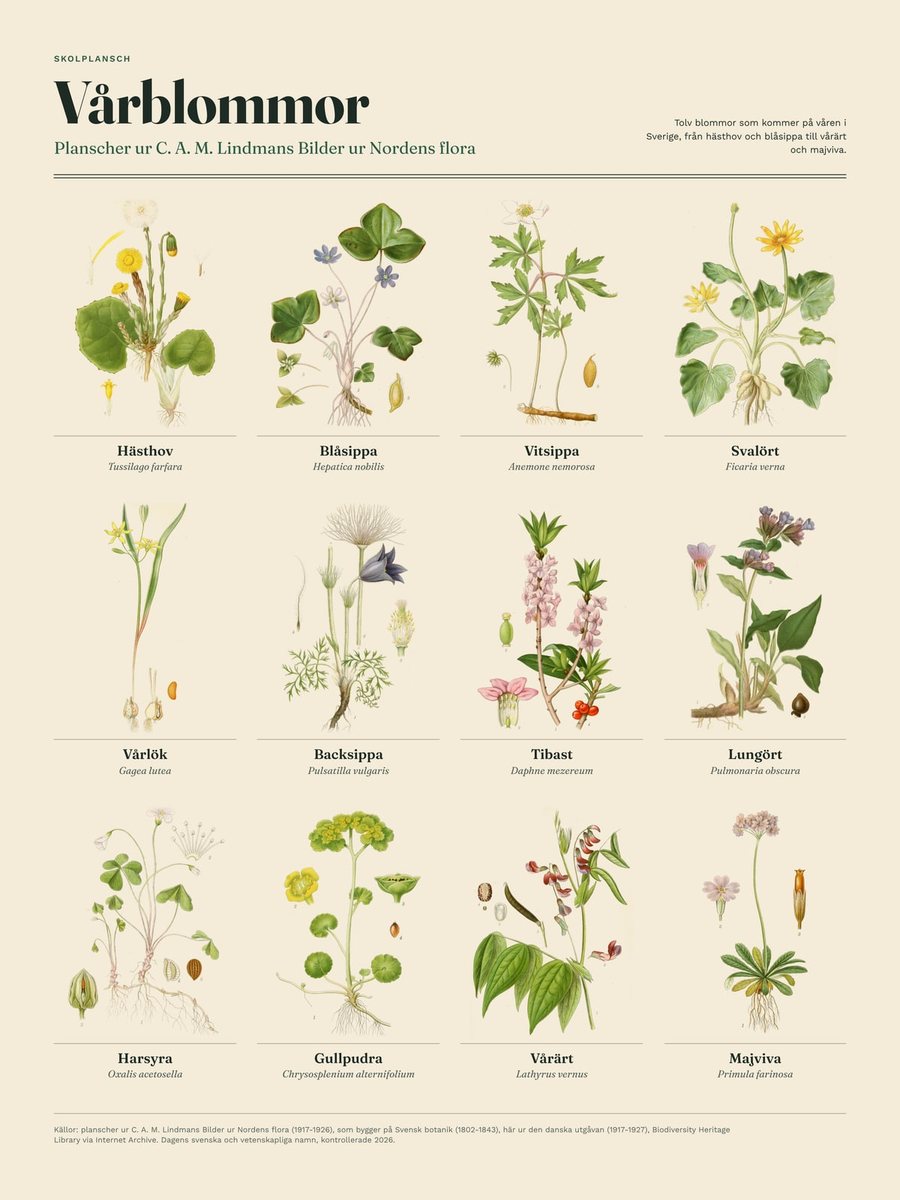
Yellow spring flowers
- Hästhov, coltsfoot: one of the first flowers of spring. The yellow flowers come early in spring on stems 10-20 cm tall, and the heart-shaped leaves grow later in the spring.
- Svalört, lesser celandine: 5-20 cm tall, with shiny heart-shaped leaves and yellow flowers with narrow petals. Flowers in April and May.
- Gulsippa, yellow anemone: like the wood anemone but yellow, 10-25 cm tall with two or three flowers. Flowers in April and May.
- Vårlök, yellow star-of-Bethlehem: two to seven small yellow flowers in a cluster on the stem. It grows in deciduous woods and parks, mostly in southern Sweden up to Uppland.
- Gullviva, cowslip: yellow flowers on a stem above a rosette of velvety leaves. Flowers in May and June and is the provincial flower of Närke.
- Gullpudra, golden saxifrage: small, with tiny yellow-green flowers without petals.
Blue and purple spring flowers
- Blåsippa, hepatica: 10-15 cm tall, with blue flowers, sometimes reddish or white. The leaves are three-lobed, leathery and reddish underneath, and they stay on through the winter.
- Backsippa, pasqueflower: 3-12 cm tall, with blue-violet flowers and long white hairs on the stem.
- Lungört, lungwort: the flowers are red at first and then turn blue or violet, so one plant can have flowers of several colours.
- Vårärt, spring pea: 20-40 cm tall, with pea flowers that are purple-red at first and then turn bluish. Flowers in May and June.
- Majviva, bird's-eye primrose: 10-25 cm tall, with small red-lilac flowers in a cluster. The leaves are mealy white underneath. It grows in damp meadows with lime and flowers in May and June.
White spring flowers
- Vitsippa, wood anemone: 10-20 cm tall, with one white flower 2-4 cm across and three lobed leaves a little way down the stem. Flowers in April and May.
- Harsyra, wood sorrel: slender, 5-15 cm tall, with leaves of three heart-shaped leaflets, a little like clover.
- Mosippa, spring pasqueflower: white inside and reddish or faintly violet and silky outside. It flowers in May and June and is the provincial flower of Härjedalen.
- Liljekonvalj, lily of the valley: 15-25 cm tall, with white hanging bells and usually two shiny leaves. Flowers in May and June and is the provincial flower of Gästrikland.
Tibast, mezereon, which is also on the poster, is a small shrub. It is poisonous, especially the berries, so leave it alone.
May you pick spring flowers?
Yes. Under the Swedish right of public access (allemansrätten) you may pick wild flowers that are not protected. Pick with care, and do not dig up plants, bulbs or roots. National parks and nature reserves may have other rules.
Some spring flowers are protected and may not be picked. The spring pasqueflower (mosippa) is protected all over Sweden. All wild orchids are protected too. Hepatica, wood anemone, cowslip and lily of the valley are not on the list of protected plants, so you may pick a bunch of them. Protection can also apply in a single county only, so check your county administrative board's website if you are unsure.
The poster
Our school chart Vårblommor (Spring flowers) shows twelve wild spring flowers: coltsfoot, hepatica, wood anemone, lesser celandine, yellow star-of-Bethlehem, pasqueflower, mezereon, lungwort, wood sorrel, golden saxifrage, spring pea and bird's-eye primrose. The pictures are colour plates from the botanist C. A. M. Lindman's Bilder ur Nordens flora from 1917-1926, with flowers, leaves and roots. We also have the cowslip and the lily of the valley on posters of their own. The posters are in Swedish.
Twelve wild spring flowers from Lindman's Bilder ur Nordens flora on one school chart.